Showing posts with label jane austen. Show all posts

Thursday, December 30, 2010

All I Want for the New Year ... Is More Jane Austen

For me, the past few years have offered a cornucopia of Jane Austen film and television adaptations. I began blogging when the Jane Austen Book Club was being filmed.  In 2007, PBS offered Jane Austen season, and I was in seventh heaven watching the remakes of Mansfield Park, Persuasion, and Northanger Abbey. In 2008 we viewed Sense and Sensibility and Miss Austen Regrets, and 2009 gave us Lost in Austen. Earlier in 2010 we watched Emma. What joy!

In January of 2011 we can expect the theatrical release of Prada to Nada, a modern Latino take on Sense and Sensibility, and there are rumblings that Pride and Prejudice and Zombies will actually be made. But then, I fear, the future of Jane Austen film making will hit a dry spell.

Oh, book publishers are printing plenty of Jane Austen sequels and prequels and mysteries, and the like. Excellent anthologies, such as A Truth Universally Acknowledged: 33 Great Authors on Why We Read Jane Austen, have been released. Collateral series, such as Amanda Vickery's At Home With the Georgians, provide us with insights about life during the time of Jane Austen, but ... what does the cinematic future hold for Janeites who simply can't get enough of Jane Austen's writing and her characters? Here is my wish list, if producers are paying attention:

Rachel Hurd Wood as Catherine?
A remake of Northanger Abbey: Let's finally do justice to Jane's fine Gothic tale, and give this novel enough time to develop cinematically in a two-part, four-hour series. Let's take advantage of Henry Tilney's wit and young Catherine's wide-eyed innocence, and leave the overblown Gothic scenes to the first two inadequate NA adaptations.

The casting of Henry Tilney would be crucial, although I did fall a little in love with J.J. Feild in the woefully short 2007 ITV remake.


Minnie Driver as Lady Susan?
Lady Susan: I think a film with Jane's anti-heroine at its center would be quite popular in this cynical age. More Dangerous Liaisons than Persuasion, Lady Susan and her machinations will strike a chord with modern audiences, who will see Jane Austen's talent for creating vivid characters in a new light.


Cassandra's drawings
The History of England: Young Jane's irreverent chronicle of the History of England would be a delightful basis for a tongue in cheek cartoon in the tradition of South Park or ( for those of you who are old enough to remember) Rocky and Bullwinkle, which you can see on YouTube.

Using Cassandra's drawings, I can see this short book translated into a rollicking 1/2 hour of fun that is sure to go viral with history fans.

What say you?

Friday, November 5, 2010

Friday Follow

This Friday we follow Andrew Lang, whose lovely letter to Jane Austen After Her Death is thought-provoking, though at first not easy to grasp. Here are two excerpts:
You are not a very popular author: your volumes are not found in gaudy covers on every bookstall; or, if found, are not perused with avidity by the Emmas and Catherines of our generation. ‘Tis not long since a blow was dealt (in the estimation of the unreasoning) at your character as an author by the publication of your familiar letters. The editor of these epistles, unfortunately, did not always take your witticisms, and he added others which were too unmistakably his own. While the injudicious were disappointed by the absence of your exquisite style and humour, the wiser sort were the more convinced of your wisdom.
The letter is filled with irony and needs a second reading, for Mr. Lang's language is old-fashioned. His thoughts take us on meandering and eventually satisfying read:
Your heroines are not passionate, we do not see their red wet cheeks, and tresses dishevelled in the manner of our frank young Maenads. What says your best successor, a lady who adds fresh lustre to a name that in fiction equals yours? She says of Miss Austen: “Her heroines have a stamp of their own. THEY HAVE A CERTAIN GENTLE SELF-RESPECT AND HUMOUR AND HARDNESS OF HEART . . . Love with them does not mean a passion as much as an interest, deep and silent.” I think one prefers them so, and that Englishwomen should be more like Anne Elliot than Maggie Tulliver.

Tuesday, October 26, 2010

The Jane Austen Editing Controversy Continues: Thoughts From Brazil About Katrhyn Sutherland's Statements

19th century hornbook and speller
Statements by Kathryn Sutherland, professor of St. Anne's College (Oxford) and Jane Austen's Fiction Digital Edition Manuscripts project coordinator, were recently published in various newspapers. They have generated great discussion online, and controversy resulted, including in my country, Brazil.

Professor Sutherland's quotations, published on the Oxford website, are the basis for this post.

The headlines in Brazil generally said: "Escritora Jane Austen era péssima em ortografia" ["Jane Austen was bad at spelling"] Folha de Sao Paulo, Veja Magazine and Correio Brasiliense.

Two British headlines were more cautious. The BBC declared, "Jane Austen's style might not be hers, academic claims." The Telegraph stated, "Jane Austen's famous prose may not be hers after all " and The Guardian made it clear that an "Attack on Jane Austen's genius shows neither sense nor sensibility ".

The headlines, which at first I thought were exaggerated, were not. They are perfectly in line with the original Oxford declaration: "Austen's famous style may not be hers after all".
Anne Hathaway as Jane Austen
We can instantly see that fair copies of the six published books were not part of the repertoire of over 1,100 pages that Professor Sutherland studied, therefore the mastery of Jane on Emma and Persuasion obviously could not be found in these 1100 manuscripts pages." Nevertheless, Sutherland concluded:
‘But in reading the manuscripts it quickly becomes clear that this delicate precision is missing. Austen’s unpublished manuscripts unpick her reputation for perfection in various ways: we see blots, crossings out, messiness; we see creation as it happens; and in Austen’s case, we discover a powerful counter-grammatical way of writing. She broke most of the rules for writing good English. In particular, the high degree of polished punctuation and epigrammatic style we see in Emma and Persuasion is simply not there.’
Before analysing the quote below, we must clarify that no reputable publishing house publishes a book without preparing an author's work. William Gifford's edits were thus not exceptional.

The expressions "heavily involved" and "Gifford as the culprit", and the assertion that "The famous style of Jane Austen can not be hers after all" set the tone for suspicion. Were the errors in the manuscripts so many and the corrections so deep that they modified Jane's style?
‘This suggests somebody else was heavily involved in the editing process between manuscript and printed book; and letters between Austen’s publisher John Murray II and his talent scout and editor William Gifford, acknowledging the untidiness of Austen’s style and how Gifford will correct it, seem to identify Gifford as the culprit.’
Sutherland speaks about the first books published by Thomas Egerton:
Sense and Sensibility, Pride and Prejudice and the first edition of Mansfield Park were not published by Murray and have previously been seen by some critics as examples of poor printing – in fact, the style in these novels is much closer to Austen’s manuscript hand!’
While discussing Jane's innovative writing (quotes above), Sutherland also points out endless paragraphs, blots, crossings out and messiness in her manuscripts
‘The manuscripts reveal Austen to be an experimental and innovative writer, constantly trying new things, and show her to be even better at writing dialogue and conversation than the edited style of her published novels suggest,’ she says.
‘She is above all a novelist whose significant effects are achieved in the exchanges of conversation and the dramatic presentation of character through speech. The manuscripts are unparagraphed, letting the different voices crowd each other; underlinings and apparently random use of capital letters give lots of directions as to how words or phrases should be voiced.’
Professor Sutherland concludes by talking about the satire in the author's writings, and saying that Jane Austen's last unfinished work is less smooth than her published works.
‘Austen was also a great satirist. This thread in her writing is apparent in the sharp and anarchic spoofs of the teenage manuscripts and still there in the freakish prose of the novel she left unfinished when she died. The manuscript evidence offers a different face for Jane Austen, one smoothed out in the famous printed novels.'
Kathryn Sutherland
The controversy about the style of Jane Austen is based solely on information from Professor Kathryn Sutherland and her study of the online manuscripts. In my opinion it is impossible to claim that the writing of Jane Austen has been softened or modified in such way that Jane's writing style can no longer be called her own.

And just what led to this controversy? The professor herself with her assertions and contradictions. Perhaps it was advertising for the online manuscript, of which Sutherland is the coordinator (see AustenBlog). Perhaps it was simple vanity to launch a theme that she knew would arouse public interest. (Read about the brouhaha in Jane Austen's World ).

I will end this post by highlighting two passages of the text by Jonathan Jones in The Guardian with which I totally agree:
Jane Austen’s style is not a bit of polishing on the surface of her novels, it goes deep into their structure, which is why they are so satisfying.
There is a dance between academics and arts reporters that has gone on long enough, in which scholars allow silly overinterpretations of their claims to become news, while at the same time looking down on the newsmonger. In this case the result is a pedantic assault on genius that can only diminish the pleasure of readers and confuse students. Austen is a great artist – through and through. Her voice is her own.

More about professor Kathryn Sutherland:


Posted by Raquel Sallaberry, Jane Austen em Português

Saturday, October 16, 2010

Cliched Thinking About Jane Austen's Novels

Here's a clichéd statement if ever there was one:
Romances are constructed around the idea that love is an obstacle course, but if you keep your nose to the grindstone, the rewards can be immense.
That is actually the theme of every Jane Austen novel, and of every movie based on a Jane Austen novel. Romances are built upon the idea that Prince Charming actually exists, but he may be a bit rough around the edges or temporarily unavailable, like Mr Rochester in Jane Eyre or the long-lost boyfriend in A Very Long Engagement, or the weird guy who keeps popping in from the future in The Time Traveller's Wife.
Joe Queenan, obviously a dude, writes for the Guardian Co UK. In his article, Joe Queenan's Guide to Romantic Cliches, he writes in a clichéd way about every clichéd romance plot he can think of. Queenan jumps seamlessely from classic novels to films, making no distinction between the two. Really, Joe. Really? Is there truly no distinction between a classic novel that has managed to persist through the ages despite stiff competition, and some cheap Hollywood film like How to Lose a Guy in 10 Days that was hurriedly thrown together for the masses with a couple of B actors?

I am tired of romances being such easy targets for both male and female critics. Frankly, the shoot 'em ups and world weary dramas with enigmatic endings that leave the reader or watcher wondering what the heck they'd just been spending their time slogging through are equally clichéd. It is a rare occasion, indeed, when a writer conjures up a story so original that nary a single cliché was used once.

So why is it always open hunting season on romances, but not on the other clichéd genres? Is this simply an accepted form of female bashing, since females overwhelmingly prefer this genre? Feel free to vent in the comment section below.

Wednesday, August 18, 2010

Thoughts About Jane Austen

Poking around the internet always leads to interesting new trails and information. Case in point, the Bookstove, a site that collects articles and reviews. Two anti-Jane posts caught my eye:

Going off Austen: This writer is considering taking Pride and Prejudice off her book shelves. Do you agree, disagree? Inquiring minds want to know.

Five Reasons Why Mr. Darcy Can't Satisfy Today's Woman is sure to get your goat. Or perhaps not if you are a Mr. Knightley, Colonel Brandon, or Henry Tilney fan. Enjoy the article, then let us know what you think of the author's opinion!

(Icons created for a 2007 Jane Austen Today contest)

Wednesday, August 11, 2010

Drawing Jane Austen

Jane Austen's image in a book

Sketching Jane Austen

Jane Austen's silhouette major big time

Warhol Jane

Jane surreal modern

No matter how you slice it or dice it visually, Jane Austen rocks!

Saturday, July 3, 2010

How Would Jane Austen Expect One to Behave at a July 4th Picnic?

T'is a truth universally acknowledged that one must not lose sight of the rules of civil engagement during alfresco dining, when men's knobby knees and a lady's bare feet are as much on display as the refreshments, entertainments, and illuminations.


  • An r.s.v.p. is obligatory, as is a token of a gift, if even of a bouquet of seasonal flowers from one's garden or a jar of preserves.
  • To be accompanied by more individuals than were invited, and to encourage such behaviour, is tres outre. Pug, while loyal and adorable, should remain at home to guard the family estate.
  • Upon entering the lawn, one must immediately seek out one's host and hostess, introducing everyone in the party, and depositing one's contribution to the delectations at the host's discretion. They have often already made plans of where your bags of Cheetohs, home- made salsa, or bowl of layered chopped salad should reposit.
  • If one has promised to contribute to cubes of ice, the disposable cutlery and china, alcoholic libations, or that which today is known as an appetizer, one must be sure to be among the first of the guests to arrive.
  • Make sure your carriage does not block those of the first arrivers, unless one hands the keys to the valet, who shall take on the responsibility of the safe-keeping of your vehicle.

  • Should its normally placid and sunny temperament be influenced to the extreme by the collick or an excessive dislike of heat, noise, and bugs, consider leaving your beloved newborn heir in the hands of a nurse or governess whilst your are competing in lawn bowling or archery. The other guests, including your host and hostess, will be most grateful for your thoughtfulness.
  • Indeed, one is not always obligated to show up. Should you be suffering from an undiagnosed ague, lice infestation, measles, mumps, or influenza, consider calling for the physick and crying off your engagement. Those who stand to be infected will be forever grateful.
  • Be sure to mingle and communicate with all who have been invited. To encase oneself in a tight clique, as did Mr. Darcy and the sisters Bingley at the Meryton Assembly, is considered the height of arrogance and rudeness. Your host and hostess invited you to enjoy ALL of their companie!
  • Pay particular attention to the old and frail and young and helpless, making sure that their needs are met and that they are seated safely out of the sun. Let Emma Woodhouse's attentions to her father be your guide in this matter.

  • Try not to emulate Miss Bates at a gathering, and keep all excessive, nonsensical, and mind-numbingly boring chatter to a minimum.
  • Do not, like Mrs. Elton, presume to take on the duties of hostess if the affair you are attending has been arranged by a host who has the misfortune of being unmarried. If you are the particular guest of this gentleman, and have been asked to oversee the duties of hostess for the duration of the event, then expect to be congratulated for your impending marriage.
  • The volume of one's chatter must remain at a decibel level that is considered pleasing to others. Keep in mind the consequences of Mrs. Bennet's loud assertions at the Netherfield Ball, and how they affected her poor Jane.
  • The same rules apply to the playing of music. Whilst Lady Gaga may be your musician of choice, your neighbors might not think her vocal skills quite as charming.
  • Do not be passive, like Mrs. Allen at the Upper Assembly rooms in Bath, but arrange for your young protegee to be introduced to other young people with similar interests.
  • Do not actively engage in spreading gossip. Whilst this conduct is rich fodder for novelists, such behavior reflects poorly on the person who passes it on.
  • When the time for illuminations arrive, make sure that the children are safely out of harm's way and that all rules of safety are followed as fuses are lit and explosives are launched.
  • At the end of the event, do offer to help the host and hostess remove all physical evidence of your gay event, leaving the property as pristine as you found it.
  • Do not linger after other guests are gone, as did the Bennets at the Netherfield Ball, and beyond a time that is pleasing to your hosts.
Above all, do enjoy yourself excessively as you celebrate your country's birthday! - Vic

Saturday, June 26, 2010

In Work of Art, Artists and Jane Austen are Like Oil and Water

Work of Art, Bravo's latest foray into reality competition, searches for the "Next Great Artist". Fourteen artists across the U.S. vie for the title each week, when one is eliminated until the last one remains standing. In the third episode, artists were asked to create book covers for Penguin Books. Their prize? Their work of art would be published as the book's cover.

One of the great books chosen was Pride and Prejudice. We are all aware of the last wonderful Penguin edition of P&P (r), which was modern, visually appealing, yet true to the book's content. In Work of Art, Bravo has succeeded in proving that artists and Jane Austen are not a good mix. Jaclyn Santos, who graduated from the same college I attended (the Maryland Institute College of Art), seems to have concentrated more on her art as a student than on acquiring a liberal arts education, for she had not read Pride and Prejudice, was only vaguely aware of its story, and did nothing to further her knowledge about the novel once it was assigned to her.

When it came to the task of designing the book's cover, Jaclyn photographed herself from the back half naked. Not satisfied with her erotic take on P&P - (if it's about romance it must be steamy, right?) - she proceeded to create a dreadfully wispy watercolor from her photograph. To add salt to the wound of her ignorance, she spelled Jane Austen's name wrong in a font size that you can hardly read. The guest judge from Penguin books failed to succeed in not wincing when she read 'Austin'.

Yeah, I know - Lizzie in the garden holding Darcy's hat. What WAS Jaclyn thinking? Grecian statue, perhaps?

Then there's this Pride and Prejudice entry, which would have had me running to the opposite end of the store for cover instead of choosing the cover.
At least Judith, the artist of this monstrosity, got Jane's name right, but her minor spelling talent didn't save her and the judges voted her off. Judith kept spouting off about remaining true to her artistic process and vision. Creating a book cover was not what she had signed up for. (Jane Austen would have loved the irony - an artist who appears on a reality show designed to sell commercials balks at creating an assignment for a client.)

Great artists manage to follow their bliss AND adhere to a patron's wishes. Without patrons, geniuses like Peter Paul Rubens, Michelangelo, and even a lesser known artist like Elisabeth Vigee-LeBrun, would not have enjoyed successful careers. They would have struggled mightily, like Vermeer, who painted what he liked, had only one real patron (Van Ruijven) and created so few works that he largely lived in poverty. The idea of painting art for art's sake is a relatively modern late 19th-century concept. Van Gogh famously did not sell his work and lived and died in obscurity, but the reality is that most successful (and brilliant) artists do not turn down prestigious commissions, and that some of the greatest works of art came about as a direct result of a patron's wishes. Sistine Chapel, anyone? Toulouse Lautrec's Parisian posters? Dorothea Lange's images of the dust bowl?

Judith's cover of Pride and Prejudice is not for a Hungarian readership; she spelled the words backwards. Jane Austen also wrote backwards and she beat Judith by two hundred years. I'd say her letter was visually more pleasing.


Was Judith creative? Innovative? Did the judges make a mistake in voting her off? What say you?

(I must mention Miles, who had not read Frankenstein, the cover he was assigned. He read the book before tackling the project. His work of art wasn't great for it was not descriptive of the book, but he did what any professional is expected to do - learn as much as he could about the topic beforehand.

And why am I being so hard on these two artists? By agreeing to participate on a reality show, they opened themselves up to criticism by seeking fame so publicly. This does not mean that one is allowed to attack the artists personally, but I certainly felt free to comment on their indifference to the project and the book they were assigned. Had these two ladies competed in a less staged competition, my words would have been kinder and gentler, though my opinion about their art would not have changed - Vic. )

Wednesday, June 16, 2010

Jane Austen: Seen on the Blogosphere

Sally Lunn's Buns: A Recipe

Jean from The Delightful Repast shared her recipe for Sally Lunn's Buns on Jane Austen's World, and a short history of tea during Jane Austen's era. Jean's version of the bun is smaller than the behemoths one can obtain in Bath, but they are tasty nevertheless!

Lemon Cake With Lime Curd and Pomegranate Topping

This recipe sounds delicious, and comes courtesy of JASNA New Jersey via Facebook.

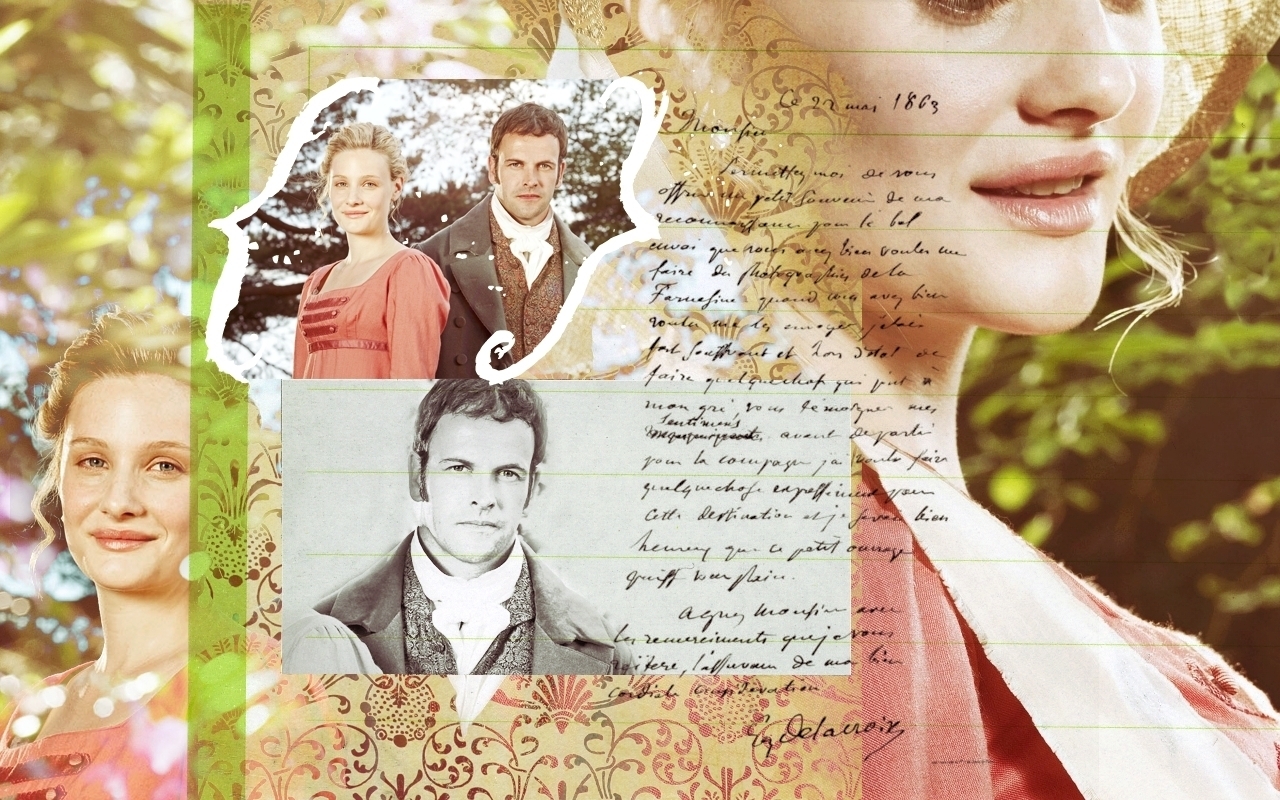
Emma 2008 Walllpaper: Quite lovely. Click on this link to download it.

A Visit to Jane Austen's House

M.E. Foley visited Jane Austen's House and wrote an interesting blog post about it, publishing a large number of pictures. Not to be outdone, our very own Tony Grant posted his thoughts about his visit to Chawton Cottage on his own blog, London Calling. Mark Whitfield Photography visited Jane Austen's house as well and interestingly concentrates on two prints of the era instead of interior shots. I love these personal bogs posts and photos from different perspectives.

Fireplace in Jane Austen's bedroom at Chawton Cottage, taken by Tony Grant. Jane and her sister, Cassandra, shared the bedroom, and one can imagine them chatting at night near the warmth and light of the fire.

Sunday, June 13, 2010

Sanditon by Jane Austen: A Review

In 1817 Jane Austen was dying. Various commentators looking at the evidence from letters written by members of her family describing her symptoms have come up with various theories as to what her illness was.

For many years people thought it was Addisons disease,. Then many thought she was suffering from Hodgkins Lymphoma, a virulent cancer. The latest diagnosis is bovine tuberculosis which is caught by drinking unpasteurised milk.

The symptoms of this illness do not make pleasant reading. Jane would have suffered chronic bouts of coughing, regular fevers, night sweats; she would be spitting blood stained sputum and she would have had sever weight loss.
Despite this, Jane was still writing. We have letters from her to various members of her family , the last dated Thursday 29th may 1817. She wrote to Francis Tilson from Mrs David’s, College Street, Winchester,

“My attendant is encouraging, and talks of making me quite well.”

She was positive and hopeful to the last. But not only letters, Jane began a new novel in January 1817 that she called, The Brothers. This was later renamed, for publication, by her own brother Henry, Sanditon. She abandoned writing it on March 18th.

Sanditon is a gem of a piece. It is an uncut diamond. It sparkles with her wit, intelligence, and genius. It is biting and insightful. It is her last shout at the world she knew. I say, shout, because as we know Jane was a private person. She courted no publicity, but the mere power of her ideas whispered in her quiet corner of the world are so powerful they gain velocity and volume by their meaning.

Jane’s last work is 55 pages long. It is written, as she wrote her letters, with abbreviations and ampersands. It is a work in progress.

The story of Sanditon is the story of the changing world Jane lived in. It is about the development of a new type of town, the holiday seaside resort. The development of the seaside towns we have nowadays all originate from that Regency Period. Places such as Weymouth, Bournemouth, Brighton Worthing and Eastbourne. They are all along the South Coast of England.

It tells the story of Mr Parker, who in conjunction with wealthy Lady Denham, has bought land and property in a small fishing village called Sanditon. They are in the process of building Regency terraces, villas and hotels. They have also built a library which was thought necessary and suggests they were trying to attract a certain class of person.

The themes Jane is writing about are the themes that were obviously concerning her in the last year of her life. There is the development of the new town and what that process might be, but there are some more human concerns. She attacks the reading of sentimental novels that have no depth. She attacks the use of titled names.

Sir Edward uses his name and fine, meaningless words, that he has gleaned from sentimental novels, to especially woo the ladies. Charlotte Parker, the heroine of this novel, is astute and could be one of Jane Austen’s most intelligent female characters. She sees through Sir Edward, his façade, his use of big words and his shallowness of character, very quickly. Charlotte is like Jane herself, not the marrying type at all, because she is far, far too intelligent.

There is a nice cameo idea where Charlotte decides not to spend her money on the brooches and pendants on sale in the library (the gift shop.) The seaside holiday resort we have today has seen the development of the tacky retail outlet. Shopkeepers in holiday resorts are experts at attracting us to spend money on what is virtually,”rubbish.”

The theme Jane hits on that is most poignant, is hypochondria. Mr and Mrs Parker’s relations, Arthur, Diana and Susan believed themselves on the brink of some dire and death threatening disease. When they appear in Sanditon it is a surprise to realise how healthy and fit they really are. But they complain and talk about their health all the time.

It is ironic to think that Jane herself, dying from her own terrible affliction, states powerfully in this story that she believed that people should rise above their afflictions and continue with life as usual.There are lots of hints and ideas within the story, metaphors that seem to go unused or suggest a deeper meaning that is not fulfilled. We can only guess that these would have been developed if the story was complete.

At the start of Sanditon Mr and Mrs Parker are in search of a physician and they don’t find one or do they? This could be for themselves because Mr Parker sprains an ankle when their coach overturns, it could be for their stated reason, to find a physician to tend to the sick of Sanditon, it could be for their own relations or it could be a metaphorical physician to heal Sanditon because the development of the town is not going well. They persuade the Haywoods, who they meet on their travels and stay with while Mr Parker’s ankle heals, to take their beautiful daughter Charlotte with them. Charlotte, wise, very intelligent and a strong character, could be “the physician,” for Sanditon. She has a clear sharp vision of the world and people around her. The novel doesn’t develop far enough for us to find out what influence Charlotte does have in the end.

Jane called the story, The Brothers. This might suggest that Mr Parker and his brother Arthur may have more of a role together as the novel, would have progressed.

In it’s present form, Sanditon, is a better title.

The story finishes abruptly when Charlotte, who has met Lady Denham in the home of the Parkers on many occasions, goes to visit Lady Denham in her own home, Sanditon House, for the first time. She is waiting for Lady Denham in the waiting room admiring the portraits of Lady Denham’s two dead husbands.

Jane herself must have been in similar rooms and for a similar purpose, visiting to take tea with an acquaintance in their big house.

Perhaps Jane felt at the time she wrote this, that she too was waiting, waiting for the afterlife.
There are some very powerful themes and ideas in this short last piece to get your teeth into.
It is a statement of Jane’s thoughts and views as she was dying. I hope nobody thinks of polishing it or trying to complete it. It is a perfect jewel in it’s own right. It is Jane’s true voice. It left me with a powerful feeling that I had touched a little of the human condition. It changed me.


Returning to my description of Sanditon as Jane Austen’s, “last shout.” It reminds me of Dylan Thomas’s poem;

“Do not go gentle into that good night,

Old age should burn and rave at close of day;

Rage, rage against the dying of the light.”

Posted by Tony Grant, London Calling

Wednesday, May 12, 2010

Jane Austen Question Found Online. I've No Sympathy: Do You?

Student Question:
RE: Jane Austen. I know the best way to get an answer about an author is to read the author's books, but here's the DL. I have one night to write ten journals on Romeo and Juliet. One has to do with love at first sight. I can't read a whole Austen from 12:48 AM tonight until tomorrow when I have to write it. So, in your experience as a reader, do Austen's books have a common theme at least loosely related to love at first sight? BTDubs, I consider this news, for anyone who felt like mentioning that I put this under news & politics. THANKS!!! <3>

Answer (not mine, though I heartily agree):
Probably shouldn't have been procrastinating until the last minute to do your homework.

Thursday, April 22, 2010

Jane Austen in Bath

Seen on the blogosphere, a nice post about Jane Austen in the City of Bath. Click here to read the post on The Quillcards Blog.

Image is from the site.

Thursday, April 15, 2010

Jane Austen Miniatures


These Jane Austen objects are amazingly small and realistic. Find a bonnet and writing desk no bigger than your fingers at Honey and Bee, where they can be special ordered. The tiny books are made of leather and archival paper. The scale is 1:12. View more items atAusten Inspiration.

Wednesday, February 17, 2010

Winners Announced in the Mr. Darcy's Great Escape Grand Giveaway

Congratulations to the three lucky winners drawn at random from the comments on the Grand Giveaway of the Pride and Prejudice Continues Series by Marsha Altman. Each of the three winners will receive one copy each of The Darcys & The Bingleys, The Plight of the Darcy Brothers and Mr. Darcy's Great Escape. The winners are...

Laura Hartness, Ollie Otson and Jami

Winners please contact us at JaneAustenToday at yahoo dot com with your online moniker, full name and address before Wednesday February 24th, 2010 to claim your prize. Shipment to US and Canadian addresses only.

Thanks to all who contributed your great comments and to Sourcebooks for contributing the giveaway prizes.

Vic, Jane Austen's World & Laurel Ann, Austenprose

Tuesday, February 9, 2010

Meet the next Mr. Darcy – Caleb Grusing

Yes Janites. Just when we thought that Aisha, the new Bollywood take on Jane Austen’s Emma was the last new adaptation in the pipeline, indie production company PaperCut Productions LLC has announced a new contemporary movie of Pride and Prejudice. According to the Pride and Prejudice 2005 blog, who seem to be the only source of information at the moment, filming will begin in Colorado in June 2010. Check out the cast and photos on the official P&P 2010 web page on the PaperCut’s website. Of particular note is actor Caleb Grusing who will be portraying the iconic Mr. Darcy. Big boots to fill for sure, but he is certainly easy on the eyes.

Follow PaperCut Productions on Twitter
Follow actor Caleb Grusing on Twitter

Cheers, Laurel Ann, Austenprose

Monday, February 1, 2010

Giveaway: Enter a Chance to Win a copy of Mr. Darcy Broke My Heart

Another author interview and giveaway at Austenprose. Discover author Beth Pattillo’s inspiration for writing Mr. Darcy Broke My Heart, her new novel that was officially released today and enter a chance to win one of three copies and one set with her previous novel Jane Austen Ruined My Life by leaving a comment at Austenprose. Contest ends Sunday, February 7th, 2010 so don’t delay.

Read two Austen bloggers opposing reviews of this new novel: Vic’ at Jane Austen’s World and mine at Austenprose.

Cheers, Laurel Ann, Austenprose

Deconstructing Miss Emma Woodhouse: Vote today!

Who is that spoiled “troublesome creature” that we love to hate in Jane Austen’s classic novel Emma? The handsome, clever and rich Miss Woodhouse of course. Who is your favorite Emma Woodhouse, Jane Austen’s original or one of the several screen interpretations? Join in the deconstruction of Miss Emma Woodhouse and vote for your favorite Emma today at Austenprose.

What others are saying about Miss Woodhouse too!

Cheers, Laurel Ann, Austenprose

Tuesday, January 26, 2010

Pride and Prejudice 2005 released on Blu-ray

Pride & Prejudice 2005 was released on Blu-ray today!

Description from distributor: Academy Award® nominee Keira Knightley stars in the greatest love story of all time. When Elizabeth Bennet (Knightley) meets the handsome Mr. Darcy (Matthew Macfadyen), she believes he is the last man on earth she could ever marry. But as their lives become intertwined, she finds herself captivated by the very person she swore to loathe for all eternity. Jane Austen’s masterpiece novel comes to the screen in the film critics said “makes you believe in true love and happily-ever-after” (Stephen Holden, The New York Times).

Follow this link to read a review for the Blu-ray edition of P&P 2005 at Monsters and Critics
Buy two DVD’s, including Blu-ray and get the 3rd free at Barnes & Noble (limited time offer)

Enjoy! Laurel Ann, Austenprose

Saturday, January 23, 2010

Great new Emma (2009) music video


Beautiful montage video of stills from the new Emma (2009) miniseries which begins tomorrow night on Masterpiece Classic set to soundtrack music The Last Dance by Samuel Sims from the production. Amazing! Created by Katherine of November's Autumn. Enjoy!

Cheers, Laurel Ann, Austenprose

Friday, January 22, 2010

Follow Friday: Kali of the Emma Adaptations Pages

Kali Pappas is the preeminent online authority of movie adaptations of Jane Austen’s novel Emma. On her lovely and informative website the Emma Adaptations Pages, you will find a hub of resources including production information, casting, images, reviews and her insights and impressions on all of the Emma adaptations and variations such as Clueless.

Be sure to take her popular Austen Heroine Quiz to discover if you could be an Elizabeth Bennet or Elinor Dashwood. (I am Fanny Price! Surprised?)

You can follow Kali on Facebook, Twitter and at her strangegirl blog. She will also be co-hosting the Emma Twitter Party along with Vic and myself on Sunday, January 24th, 9:00-11:00 PM ET on Twitter and Tweetgrid brought to us by the great folks at Masterpiece Classic PBS.

Visit the Emma Adaptations Pages
Read Kali’s post here on Fashionable Emma Woodhouse
Visit the official Emma Twitter Party page at Masterpiece Classic


Cheers, Laurel Ann, Austenprose